

“But I just want to start writing!”
That’s the exciting work, right? You write an article and wait a few months to see if Google gifts you rankings and traffic. And when you see that traffic come in, it feels amazing. You know you’ll be positioned for long-term success.
That’s where a content calendar comes into play, offering a clear and structured roadmap for your content marketing strategy, and a way to consistently drive traffic with every post. The best part is that there’s a solution to create a content calendar in minutes! But we’ll get to that in a second.
An effective content calendar keeps your marketing efforts aligned with your goals and ensures that you’re producing the right content at the right time to attract and retain your target audience. In this guide, we’ll explore the step-by-step process of creating an engaging content calendar to drive organic traffic and boost conversions. So, let’s get started!
Setting Goals
The first step in creating a content calendar is determining its purpose and setting measurable goals. Your primary aim should be to increase organic traffic and conversions, but you also want to enhance brand awareness, improve customer engagement, and establish your authority in your niche. Keep these objectives in mind when setting your goals, and be realistic about what you can achieve within a specific time frame.
Aim for 1 -2 quarters (or 3-6 months). A lot can change in that timespan and you may be wasting effort by planning for an entire year, knowing the roadmap could change.
Defining Your Target Audience
To create content that resonates with your readers and drives desired results, you need to define your target audience. Start by creating buyer personas—semi-fictional representations of your ideal customers—incorporating demographics, psychographics, and behavioral data. Analyze your existing audience through web analytics, CRM data, and social listening tools to identify their content preferences and common pain points. This information will serve as a vital foundation for your content planning efforts.
Start with what is already successful. If you have content that drives traffic and conversions, you know your target audience is already interested in that type of content.
Content Planning
Now that you have a clear understanding of your target audience, it’s time to plan the type of content you’ll create. Below are some popular content formats:
- Blog posts
- Infographics
- Videos
- Social media posts
- Podcasts
How to Create your Content Calendar: The Step-by-Step Process
With your content formats in mind, follow these steps to generate topic, keyword and blog post ideas. Search Alkemy can run all of these steps for you automatically to speed up the process. After the automated keyword research process, you can get a prioritized calendar like this:
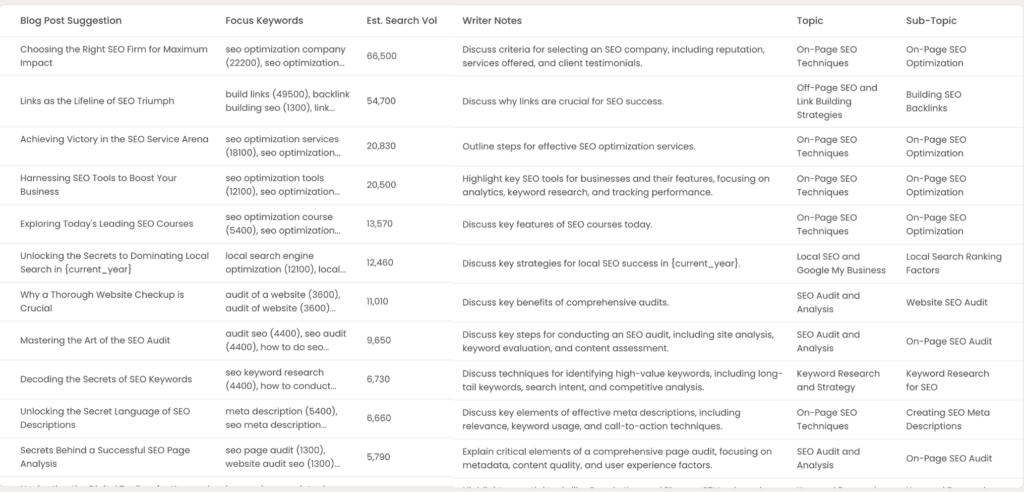
BUT, if you’d like to perform it manually, here are the steps:
- Create a List of Seed Keywords: Seed keywords are the foundation of your keyword research. These are the primary terms or phrases related to your niche or industry. Brainstorm a list of seed keywords by thinking about the words your target audience might use when they search online for information related to your niche.
- Utilize Keyword Research Tools: Use keyword research tools like Search Alkemy or Ubersuggest to input your seed keywords and generate a list of related long-tail keywords and phrases. These tools provide valuable information about each keyword’s search volume, Keyword Difficulty (KD), cost per click (CPC), and other metrics that give insights into the competition and profitability of each keyword.
- Analyze Keyword Difficulty and Search Volume: It’s essential to target keywords with a difficulty score that you can realistically rank for on search engine results pages (SERPs). For new websites with low domain authority, target keywords with low difficulty scores. As your site gains more authority, you can gradually target more competitive keywords with higher search volumes.
- Categorize Keywords Based on User Intent: Group your researched keywords based on the user intent (i.e., informational, navigational, commercial, and transactional). This classification helps to ensure your content aligns with your target audience’s search intent and provides them with the information they’re seeking.
- Organize Keywords into Topics: Combine related keywords into content topics or themes, ensuring that each topic has a primary keyword and some secondary keywords. This approach makes it easier to create high-quality content that covers all relevant aspects of a subject and ultimately improves your chances of ranking higher in search engine results.
- Prioritize Keyword Topics: Rank your keyword topics based on their search volume and KD. Prioritize those with the highest search volume and a KD score that your website is capable of ranking for. This priority list will help you develop your content calendar while considering the potential performance of each content piece.
- Look Out for Keyword Opportunities: Keep an eye on new keyword opportunities by regularly monitoring your competitors’ content and staying updated on industry trends. Tools like Ahrefs’ “Content Gap” analysis can help you find keywords that your competitors are ranking for, but you haven’t targeted yet.
Organize your content ideas in a spreadsheet, prioritizing them based on audience impact, relevance, and feasibility.
Establishing a Posting Schedule
Determining the optimal posting frequency is crucial for maximizing your content’s reach and engagement. Analyze your audience’s online behavior and consider your content creation capacity when setting your posting schedule. Based on these factors, create a content calendar template using tools like Google Sheets, Excel, or Trello, and assign dates and times for each piece of content.
Develop a content calendar template
Create a content calendar template that includes columns for:
- Draft due date
- Publishing due date
- Topic
- Slug/URL
- Focus Keyword(s)
- Content type
- The target audience
- Call-to-action
- Performance/Success metrics
- Assigned content creator
- Assigned editor
Fill in the posting schedule: Populate the content calendar template with planned content, keeping your posting frequency, audience preferences, and content mix in mind. Ensure you have a good balance of evergreen and trending topics.
Content Creation
Once you have outlined your content calendar, it’s time to bring your ideas to life. Assign content creation tasks to your team members, defining clear roles, responsibilities, and deadlines. Utilize project management tools like Asana or Basecamp to streamline task organization and tracking.
When creating content, keep these SEO best practices in mind:
- Include focused keywords naturally throughout the content, avoiding overuse or “keyword stuffing.”
- Incorporate internal and external links to authoritative websites, improving content relevance and navigation.
- Optimize on-page elements, such as title tags, meta descriptions, URL structure, and header tags, to improve search engine visibility.
Remember that quality and engagement are critical factors in driving organic traffic and conversions. Therefore, focus on creating valuable, relevant, and informative content that addresses your audience’s needs and preferences.
Keep in mind that there are all kinds of content “angles”: Evergreen content, seasonal content, data-driven content, etc.
To speed up content production, use AI tools to create great first drafts that your writing team can improve upon. Becoming more efficient on the keyword research and content production can double or triple your output.
Content Publishing and Promotion
With your content calendar populated and your content pieces prepared, it’s time to publish and promote them according to the assigned dates and times. As you distribute your content across various channels, consider the following tips:
- Tailor your content’s format and messaging for each distribution platform to ensure consistency and effectiveness.
- Leverage social media management tools like Buffer or Hootsuite for scheduling your social media posts efficiently.
- Engage with your audience through comments and replies, fostering community and promoting conversions.
Content Calendar Maintenance
A content calendar is a living document that requires continuous updating and improvement. Keep track of your content’s performance using tools like Google Analytics or social media insights to inform future content decisions. In Google Analytics, track organic traffic and organic conversions. Track indexability and ranking progress in Google Search Console. Regularly update your calendar with new ideas, completed tasks, and adjustments to content types, topics, and scheduling based on performance and audience feedback.
After you’ve created a few weeks worth of content, run a report using keyword research tools or monitor Google Search Console to see if you rank for the keywords you identified in your content calendar. If not, you can easily re-optimize for additional organic traffic. Look for keywords in positions >10 and <30. This means that you’re close to ranking for these terms, Google sees your blog post as somewhat relevant, but you have to make that connection clearer.
Content Calendar Summary
By following these steps, you can create and maintain an effective content calendar that drives organic traffic and conversions, establishes your brand authority, and strengthens your online presence. Remember that content marketing strategies are not one-size-fits-all, so be flexible and adaptive as you refine and optimize your approach for the best possible results. With diligent planning, execution, and analysis, you can take your content marketing efforts to new heights and achieve lasting success. Happy content planning!